

Ask anyone who has lived in Davis for more than a few weeks, and they will eventually mention the bikes. The city has called itself the "Bicycle Capital of America" since 1964, was the first U.S. city to legislate and build standardized bike lanes back in 1967, became the first Platinum-rated Bicycle Friendly Community in the country (League of American Bicyclists, 2006), and built the nation's first protected intersection in 2015. More than 100 miles of paths, lanes and trails crisscross a town with over 4,000 bike racks, and the city's own logo is a penny-farthing.
A hall of fame and a loop with no obvious end
Davis is also home to the U.S. Bicycling Hall of Fame, at 303 3rd St, open as a museum since 2009, a move that festival emcee Bob Bowen helped bring to town. The festival itself runs along or near the Davis Bike Loop, roughly 12 to 13 miles of greenbelts and paths, some tracing Putah Creek, that the ride used in full from 2020 through 2023. City Councilmember Gloria Partida pushed for vinyl ground stickers and pole signs at the loop's turns between 2020 and 2022, a fix that mattered more than it sounds like: Maria Contreras Tebbutt, founder of The Bike Campaign, has noted that "seven years ago most UCD students and newcomers were unable to find the Davis Bike Loop on their own."
Good Day Sacramento's Julissa Ortiz previews the ride, October 2021.
The organizations that keep the wheels turning
The Bike Campaign and its Bike Garage locations, founded in 2011 by Maria Contreras Tebbutt, work year-round to make cycling accessible to everyone, including children with disabilities and seniors, running programs like the Polar Bear Ride, Loopalooza and the Ice Cream Ride, plus a Bike Garage in Davis at 606 Peña Dr and another in Woodland. Davis Bike Club has existed informally since the early 1970s and incorporated in May 1979 as a 501(c)(4); it runs the Davis Double Century, a race created back in 1969 by the Cal Aggie Wheelmen, and remains the only organized bike club in Yolo County with more than 500 members.
And underneath both of those is the Davis Odd Fellows, whose own bike-parade pedigree predates the zombies entirely: their 2010 attempt at "World's Greatest Bicycle Parade" set a Guinness record for the longest single line of bicycles, 916 riders, right from the Lodge steps.
"We would like to see the City of Davis once again enthusiastically claim our right to bike fame." (Maria Contreras Tebbutt, founder, The Bike Campaign)
The case for taking the title back
Contreras Tebbutt has pointed out, a little pointedly, that Sparta, Wisconsin now markets itself as "Bicycling Capital of America," a title Davis arguably earned first. Her argument is economic as much as it is civic pride: "People who ride bikes spend more money in their community." Aaron Wedra has framed the festival's own role in similar terms: "Our work helps keep Davis recognized as a zany platinum-rated bicycling community."
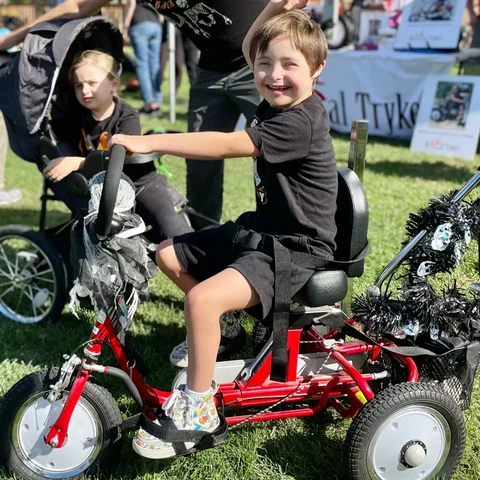
The festival's own rules make a point of not requiring a bike at all. "Although we emphasize bicycling, it is not required," the rules page reads. "All active mobility participants are invited: pedestrians, scooters, skateboards, strollers, wheelchairs, powerchairs," with mobile Halloween music "highly encouraged." That inclusivity is not an afterthought here, it is baked into a town where getting around without a car has been the default for sixty years.
Austin Oney, on his first weekend as a Davis resident in 2022, put it about as well as anyone: "We've chosen the best place in the world to raise our children!" Plan your own ride on the Bike Parade event page.
Local bike shops round out the ecosystem: Ken's Bike-Ski-Board, Davis Cyclery, Green Bicycle Depot, Apex Cycles, Freewheeler, HMP Bikes, and the city's own SPIN bike-and-scooter rental partnership. Between all of them, there is genuinely no excuse not to show up on wheels.
A parade that fits the town, not the other way around
Most zombie-themed events elsewhere in the country are built around a spooky idea first, then bolted onto whatever infrastructure a city happens to have. In Davis, the order runs the other way. The bike lanes, the greenbelts, the loop, and a community that already treats two wheels as the default form of transportation existed decades before anyone thought to add zombies to it. The festival did not invent Davis' bike culture, it borrowed it for one weekend a year, which is a large part of why it scales the way it does. A town that already knows how to move a few thousand cyclists through its streets safely does not need to build that skill from scratch just because everyone showed up in costume.
That is also why the festival's route has changed more than once, from an open 12-mile loop to a shorter led parade between Community Park and Mace Ranch, without losing its identity. The bikes were never the point on their own. The town underneath them was.